On November 19, 2026, JYP AUDITION posted an official notice warning about Telegram accounts that impersonate its casting team. The notice says the casting team does not run any Telegram account and does not ask applicants for inappropriate videos or materials. It asks anyone contacted by such an account to capture the messages and send them by DM to JYP AUDITION’s official Instagram account. It was not the company’s first warning. Back on June 24, 2025, JYP AUDITION had already published a separate notice about people impersonating its casting team and trainees. These two notices, released more than a year apart, show that impersonation attempts against one agency’s name can repeat over time.
Why a Professional-Looking Casting Message Is Not Proof
Real scouting exists in the K-pop industry. Companies do contact prospective trainees, and legitimate audition pages do exist. But a polished message proves very little on its own. Company names, logos, business cards, staff titles, social media profiles, and even Telegram accounts can all be copied or faked. According to CHOSUNBIZ, entertainment-industry sources warned that business cards, ID badges, and social-media profiles can be forged, so recipients should verify a scout directly through the company’s main telephone number or official website.
This is why the question “does this look real” is less useful than a verification sequence. Three separate questions get confused by applicants and parents: does the company exist, is it registered, and does this specific person actually represent it. A message can pass the first test and still fail the third.
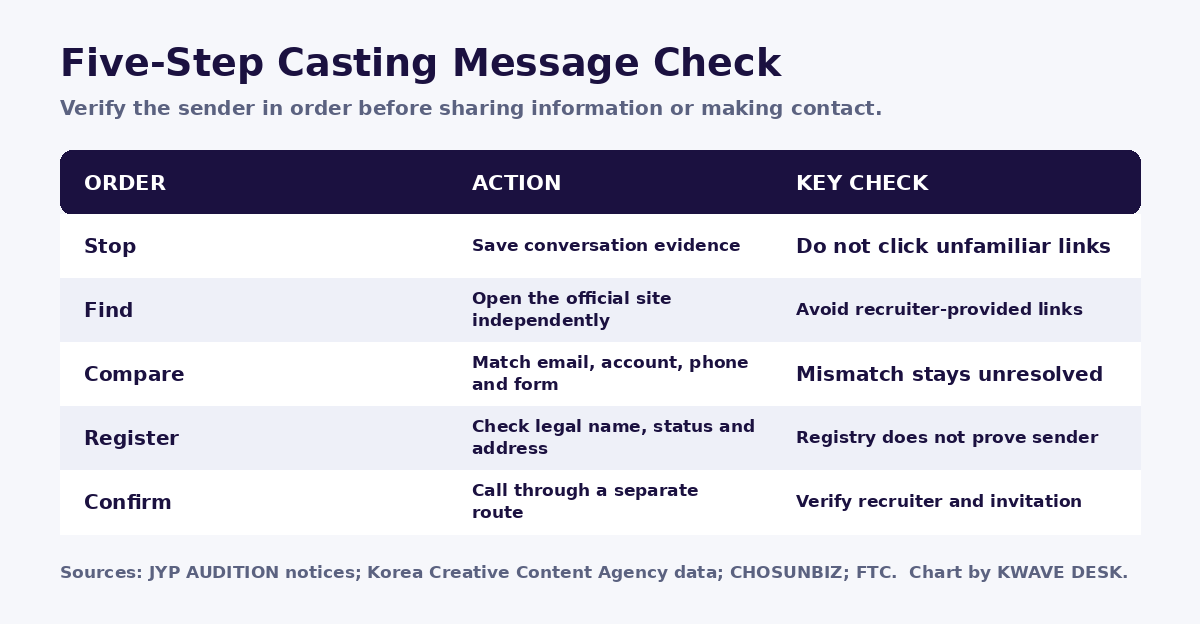
The Five-Step Verification Order
1. Stop the Conversation Before Sending Anything
Before replying further, save evidence. Screenshot the full conversation, including usernames, profile links, email headers, phone numbers, and any payment instructions. Write down the exact company name as it was typed to you, since scam accounts sometimes use near-identical spellings. Do not click unfamiliar links inside the message while doing this.
2. Find the Company Independently
Instead of using any link the recruiter sent you, open a new browser tab. Type the company’s official website address directly, or locate it through a trusted search engine result. This single habit prevents you from landing on a cloned page designed to look like the real audition site.
3. Compare the Contact Channel
Once you have the company’s own website and official social accounts open, compare them against what the recruiter sent you. Check whether the same account name, email domain, audition page, telephone number, and application form actually appear on the company’s own channels. If the recruiter’s email domain, Telegram handle, or form link does not match anything listed on the official site, treat that as unresolved, not confirmed.
4. Verify the Legal Company Name
South Korea’s Popular Culture and Arts Industry Development Act requires businesses that provide or arrange entertainers’ services, training, guidance, or consultation to register as popular-culture planning businesses. A Korea Creative Content Agency dataset, published through the Public Data Portal on August 12, 2026, lists registered popular-culture planning businesses, including legal names, registration numbers, operating status, and addresses. Searching this dataset with the full Korean legal name of the company can help confirm whether a registered entity by that name exists, and whether its listed address and status match what you were told. Our reading: a registry match only tells you the business entity exists on paper. It does not tell you that the individual messaging you works for that entity. Treat steps 4 and 5 as separate checks, not substitutes for each other.
5. Contact the Company Through a Separate Route
The final step is to reach the company through a channel you found yourself, not one the recruiter gave you. Call the official audition office or main switchboard and ask directly whether the named recruiter, the account that messaged you, the proposed meeting, and the audition invitation are genuine. According to CHOSUNBIZ, this direct verification through the company’s own phone number or website is the step industry sources specifically recommend, precisely because other materials can be forged.
Payment and Sales-Pitch Red Flags
Separate from identity verification, watch for pressure around money. The U.S. Federal Trade Commission warns that unexpected virtual casting messages can lead to high-pressure pitches for bogus photo shoots or acting classes, and states that applicants should not pay to secure a job or audition opportunity. CHOSUNBIZ separately reported cases where people posing as entertainment-company staff approached students for personal information and later promoted paid academies, training programs, or profile photography.
The FTC also lists specific warning signs in talent and modeling offers, including:
- Guarantees of work or acceptance
- Demands for upfront agency payments
- Mandatory use of one particular photographer
- Pressure to sign a contract immediately
Requests for gift cards, cryptocurrency, wire transfers, or detailed bank information alongside any of the above should be treated as serious warning signs, consistent with the FTC’s general guidance against paying for audition opportunities.
Parent Check Order for Minors
When the applicant is a minor, a guardian should join every verification call and meeting from the start. No private, secret conversation with a recruiter should happen without a parent present. One-on-one meetings in homes, hotel rooms, or other private settings should be avoided entirely. Passport copies, school details, and other detailed personal information should not be sent until both the sender’s identity and the stated purpose have been verified through the steps above.
What Official Warnings Actually Confirm
JYP’s two notices, from June 2025 and November 2026, confirm that impersonation of its casting team, trainees, and Telegram accounts has occurred more than once. The 2025 notice also says JYP trainees do not run official or personal social media channels, so an account presenting itself as a JYP trainee is not a company channel. The FTC’s casting-scam guidance confirms a separate but related pattern: unsolicited virtual casting messages tied to payment pressure in the broader talent industry. Neither source claims that every unsolicited casting message is fraudulent, and neither source describes how every legitimate K-pop agency communicates with applicants. Readers should not assume that an agency’s silence on a specific scam type means that type cannot occur, nor assume that every cold message is automatically fake.
Editor’s Take
Our reading: the most useful habit here is ordering your checks, not collecting more red flags. Many applicants already know “scammers ask for money,” but still get confused about which question they are answering when they check a business card or a registry listing. A verified badge, a business card photo, a contract image, or a registry entry can each confirm one narrow fact. None of them, alone or combined, can confirm that the specific person messaging you is who they claim to be.
Our reading: treating company existence, registration status, and sender identity as three separate questions removes a lot of the guesswork that scam messages rely on. This article does not offer legal, immigration, or contract advice; registration and legal-entity questions should be confirmed through official Korean government sources or a qualified professional.
Before You Apply
- Confirm the audition notice or casting message appears on the company’s own official website or verified channel.
- Search the Korea Creative Content Agency’s public registration dataset for the company’s full Korean legal name.
- Call the company’s main switchboard or official audition office to confirm the recruiter’s identity independently.
- Check JYP AUDITION’s official notice pages directly if a message claims to come from JYP.
- Review the FTC’s current casting-scam and modeling-scam guidance pages for updates before sending any payment or personal documents.
Related Reading
- How to Audition for a Korean Entertainment Company: Requirements, Videos and What Agencies Say They Want
- P NATION Email Audition Guide: The 1–3 Minute Clip and Self-Introduction Option
- Before You Sign a K-pop Trainee Contract: What Korea’s Standard Contract Covers, and Why It Might Not Be Enough
Sources
- JYP AUDITION · 2026-11-19
- JYP AUDITION · 2025-06-24
- CHOSUNBIZ · 2026-10-02
- Consumer Advice
- Consumer Advice
- 국가법령정보센터
- 공공데이터포털 · 2026-08-12