
A trainee contract offered to an overseas applicant sometimes lists a company name that does not appear anywhere in Korea’s official registration records. The name on the audition poster, the name on the social media account, and the name printed on the contract can all be different. This guide walks through the exact order to check those names before anyone signs anything or sends a payment.
Why agency registration belongs on your pre-signing checklist
Under Article 26 of Korea’s Popular Culture and Arts Industry Development Act, a business that provides, arranges, trains, guides or advises popular-culture artists must register as a popular culture and arts planning business. According to the National Law Information Center, this registration requires an office and at least one qualifying representative or corporate officer, who must have either two years of relevant industry experience or completion of the designated registration course.
Training or managing aspiring K-pop performers can fall within this registration system. The government process results in a popular culture and arts planning business registration certificate, issued by the competent metropolitan, provincial or local authority for the business location, according to Gov24.
Our reading: a valid registration record only confirms that a company met the legal office and personnel conditions to register. It is not an endorsement of the company’s training quality, and it does not guarantee a debut, financial success, or a dispute-free relationship.
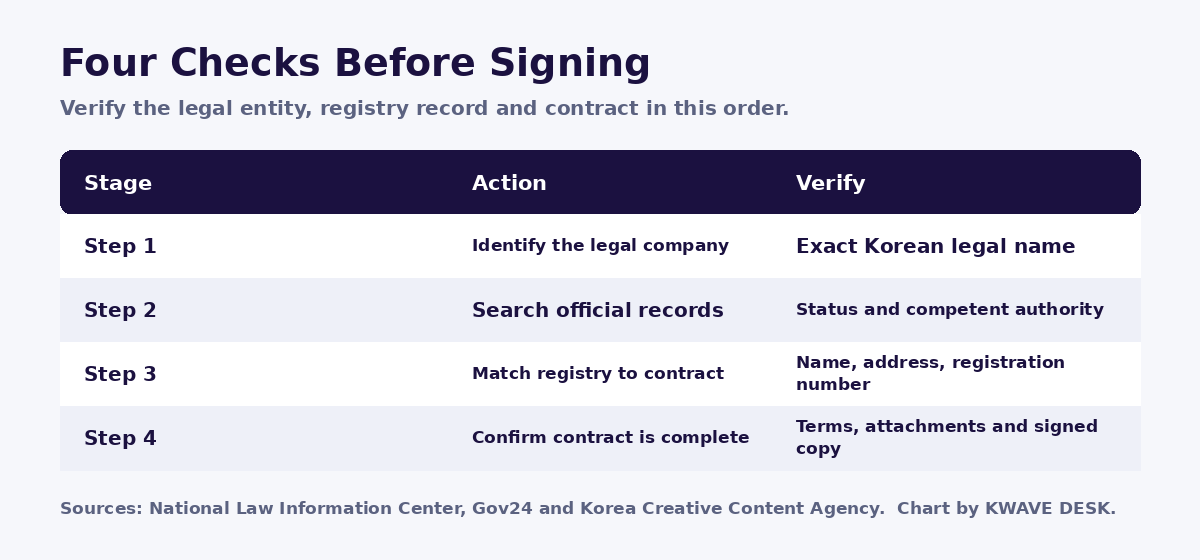
Step 1 — Identify the legal company, not only the brand name
Before searching any database, applicants need four pieces of information: the Korean legal entity or proprietor name, the representative’s name, the principal business address, and the registration number if the agency has already shared it.
An audition label, a catchy English brand, or a social media handle may not match the registered Korean business name at all. A company might promote itself under one name online while its legal registration lists a different corporate name or an affiliated entity. Applicants should ask the recruiter directly for the exact Korean legal name before assuming the familiar brand is the entity they would be contracting with.
Step 2 — Search the official registration records
Once the legal name is in hand, the next step is checking it against Korea’s official records. According to the Korea Creative Content Agency’s public dataset, registered planning businesses are listed by company name, representative, principal business address, operating status, competent authority, registration number and registration date.
Applicants should compare their information against the dataset in this order:
- Company name — does it match exactly, including any corporate suffix?
- Representative name — does it match the person named in the contract offer?
- Principal business address — does it match the office location the recruiter mentioned?
- Registration number and registration date — do these appear and look consistent?
- Competent authority — does the listed local authority match the business address?
- Operating status — is the business shown as operating, rather than suspended or closed?
The dataset identifies whether a registered planning business is operating, suspended or closed, so checking status matters as much as finding a matching name, according to the Korea Creative Content Agency.
What to do when several companies have similar names
Korean company names can repeat across unrelated businesses, especially when a name uses common industry words. When more than one record shares a similar name, applicants should compare the representative, the address and the registration number together, rather than relying on the company name alone. A match on all three points is a stronger signal than a name match by itself.
What to do when no matching record appears
If no record matches, this is not proof that the business is operating illegally. Registration databases can lag behind recent changes, and a company name might be entered with slight spelling differences. The appropriate response is to ask the company for its exact registered name and a copy of its registration certificate. Applicants can also try confirming the record with the listed competent local authority for that business address. Signing the contract or sending any payment should wait until the discrepancy is explained in writing.
Step 3 — Match the registry result to the contract
Korea’s current standard trainee contract includes a field for the agency’s popular culture and arts planning business registration number, according to the National Law Information Center. Once an official registration record is confirmed, applicants should hold the contract draft next to that record and check three things.
First, does the contracting party’s name in the contract match the registered company name exactly? Second, does the address in the contract match the registered principal business address? Third, does the registration number field in the contract match the number shown in the official record, rather than being left blank?
Several situations call for written clarification before signing:
- The company name in the contract differs from the name the applicant originally searched.
- A different affiliate or related company is named as the signing party.
- The registration number field in the contract is blank or unreadable.
- Payment instructions name a personal bank account or a third party unrelated to the registered company.
Our reading: this third mismatch, where payment goes to a name that does not match the contract or the registry, deserves particular attention. A legitimate training fee or cost arrangement should trace back to the same legal entity named in the contract, not to an unrelated individual.
Step 4 — Confirm the contract itself is complete
A matching registration record does not mean the contract text itself is complete or fair. The Act requires covered written contracts to state several specific matters, according to the National Law Information Center. Applicants can use this list as a document check before signing:
- Contract term, renewal conditions and termination terms
- Each party’s rights and duties
- Scope of services the agency will provide
- Image and content rights arrangements
- Revenue distribution terms
- Dispute resolution process
- Any supplementary agreements referenced in the main contract
The Act also requires both parties to sign or affix their names and seals to the written contract and to exchange copies, rather than leaving the only signed copy with the agency. Applicants should confirm every attachment mentioned in the contract text is actually supplied, and that they personally receive a signed copy to keep.
The Ministry of Culture, Sports and Tourism posted a revised standard trainee contract on December 23, 2025, identified as Ministry Notice No. 2025-69, with the revision dated January 1, 2026. Applicants should confirm which version of the standard contract, if any, their agreement is based on.
Registration does not replace contract review
A clean registration record tells an applicant that a company cleared a regulatory check. It does not evaluate the specific numbers inside a contract. Registration status says nothing about trainee expense arrangements, repayment language if a trainee leaves early, exclusivity terms, intellectual-property clauses, the consequences of early termination, or logistics specific to foreign applicants. These items require a separate, careful reading of the contract text itself, ideally with professional help.
Where overseas applicants can seek help
The Korea Creative Content Agency’s registered-company search system and the related public dataset are the starting points for checking a planning business’s legal name, representative, address, registration number and operating status. Applicants with unresolved questions about a specific company’s status can also raise them with the competent local authority listed for that business.
Because contract language carries real financial and personal consequences, a Korean-qualified lawyer or an appropriate public legal-support channel should review any trainee contract before signing. This article provides general information only and is not legal advice, and it does not address visa or immigration matters.
Editor’s Take
Our reading: the most common mistake among overseas applicants is stopping at the first comfortable signal, usually a familiar brand name or an active social media account. A polished online presence says nothing about whether the legal entity behind it is properly registered or whether that same entity will actually sign the contract.
Our reading: treating the three-way match — legal name, registry entry, and payment recipient — as a strict sequence, rather than checking them in any order, helps applicants notice a mismatched payment instruction that a quick glance at a company name would miss. A single mismatch is a reason to pause and ask questions, not an automatic verdict that something unlawful is happening.
Before You Apply
- Confirm the exact Korean legal name, representative, and address directly with the recruiter.
- Search the Korea Creative Content Agency’s official dataset for a matching, currently operating record.
- Compare the representative, address, and registration number if multiple similar company names appear.
- Check that the contract’s registration number field matches the official record, rather than being blank.
- Verify that any requested payment goes to the same legal entity named in the contract.
- Confirm which version of the standard trainee contract the agreement follows, and ask about any recent revision.
- Have a Korean-qualified lawyer or public legal-support channel review the full contract before signing.
Related Reading
- Before You Sign a K-pop Trainee Contract: What Korea’s Standard Contract Covers, and Why It Might Not Be Enough
- Fake K-pop Casting Messages: A Verification Checklist for Overseas Applicants and Parents
- K-pop Settlement Statements: Korea’s Annual Disclosure Rule and 45-Day Payment Clock