Why Settlement Paperwork Matters After Debut
A trainee who finally debuts often expects a single number: “how much do I get paid.” Real settlement statements are more complicated. They separate income definitions, deductible costs, split ratios, settlement cycles, and payment dates into different clauses. Treating these as one lump sum makes it hard to check whether a statement is accurate. This guide walks through the order an applicant should use to read and question a K-pop settlement statement, based only on confirmed legal and public sources.
This article is general information, not legal, tax, or immigration advice. Always confirm contract terms with a qualified attorney before signing or disputing anything.
The Two Rules Applicants Should Not Confuse
Annual disclosure
Under Korea’s Popular Culture and Arts Industry Development Act, an agency must keep accounting records separately for each affiliated artist, except where contributions to a joint service cannot be separated. Article 14 also requires the agency to give the artist relevant accounting and payable-compensation information without delay whenever the artist requests it.
The current enforcement decree adds a baseline that does not depend on a request. An agency must give each affiliated artist a written accounting disclosure at least once a year, even if the artist never asks for one. This provision, Article 2-3 of the enforcement decree, took effect on September 26, 2025. That annual document must state:
- Artist-related accounting details
- The amount the agency received from third parties for the artist’s services
- The compensation payable to the artist
- The scheduled payment time
Our reading: this annual rule guarantees paperwork, not monthly payment or guaranteed income. An artist could receive a once-a-year disclosure showing zero payable compensation if no qualifying revenue was generated. The rule is about transparency of records, not a promise of earnings.
Payment after the agency receives money
The second rule applicants often confuse with release dates is the 45-day payment clock under Article 14. When an agency receives payment from a third party for an artist’s services, the law generally requires paying the artist under the contract within 45 days of that receipt. An additional delay of up to 45 days is allowed when there is a justifiable reason.
This clock starts when the agency actually receives money from a third party, such as a broadcaster, brand, or promoter. It does not start on the concert date, the filming date, or the release date of a song. A performance can happen in January while the third-party payment, and therefore the 45-day clock, only begins months later.
Three timelines compared
Applicants and parents should track three separate timelines side by side instead of merging them into one expectation:
- Timeline A — Annual disclosure: at least once per year, regardless of request, covering accounting details, third-party receipts, payable compensation, and a scheduled payment time.
- Timeline B — Contract settlement cycle: whatever frequency the individual exclusive contract sets for calculating splits (this is contract-specific and not fixed by the law summarized here).
- Timeline C — The 45-day payment clock: starts when the agency receives a third-party payment, with a possible 45-day extension for a justifiable reason.
Our reading: a statement can satisfy Timeline A without triggering an immediate payment under Timeline C, because no third-party receipt may have occurred yet. Reading these three timelines together, instead of assuming they are one process, helps avoid misreading a document.
Read the Contract in This Order
1. Identify what counts as gross income
Before checking any numbers, locate how the contract defines income. Music streaming, live performances, advertising, broadcast appearances, and fan merchandise may each have separate definitions or separate accounting treatment. A statement that lumps everything into one “revenue” line makes it hard to verify any single category.
2. List every deductible cost
Next, find every clause describing deductible costs, such as trainee fees, production costs, accommodation, transportation, or styling. Build a simple table of each cost type, whether it is deductible at all, any stated limit, and any required approval step. Our reading: whether a cost is actually charged to a given artist depends entirely on that artist’s individual contract, so this step cannot be generalized across groups or companies.
3. Find the split and calculation sequence
Check whether the contract deducts costs from gross income first, and then splits the remainder between company and artist, or whether it splits gross income first and then assigns costs separately. This sequence changes the final payable amount even when the split percentage and cost list look identical.
4. Match reporting dates with payment dates
Finally, line up the settlement statement’s issue date, any stated period for raising objections, the scheduled payment date, and any clause addressing delay when a third-party payment itself arrives late. Placing all four dates on one personal timeline makes it easier to see whether the 45-day clock in Article 14 has actually started.
Verification checklist
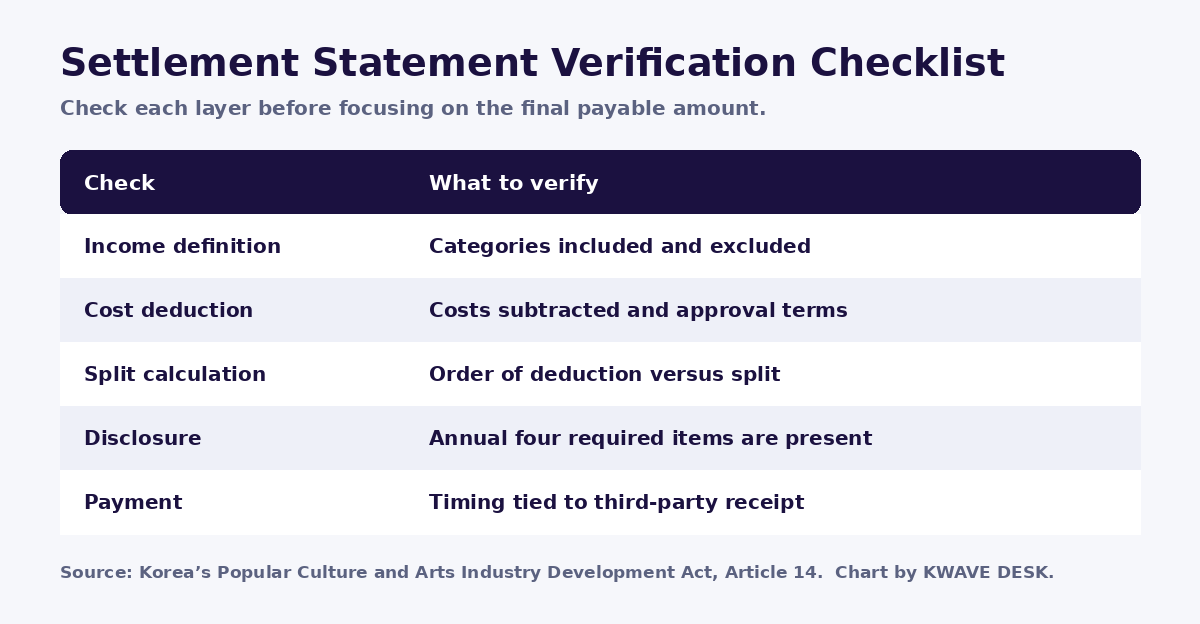
Use this five-step order whenever a statement arrives, rather than jumping straight to the total:
- Income definition — which categories are included and excluded
- Cost deduction — which costs were subtracted and under what approval
- Split calculation — the exact order of deduction versus split
- Disclosure — whether the annual four required items are present
- Payment — whether the date aligns with third-party receipt plus up to 45 days, plus any justified extension
What to Request When a Statement Is Too Vague
If a statement only shows a single total figure, asking for more detail in writing is a reasonable first step. Request, item by item:
- The source of each income stream (which platform, broadcaster, or brand)
- The exact amount the agency received from each third party
- Each deducted cost, broken out by category and amount
- The formula used to calculate the final split
- The scheduled payment date tied to that specific receipt
Asking for this documentation is not the same as alleging a contract violation or illegal conduct. Keep the request factual and focused on clarification, and raise any legal concern separately with a qualified attorney.
Extra Checks for Overseas Artists and Parents
Readers based in the United States or Canada face additional questions that a domestic trainee may not need to ask. Before signing, consider raising these points with a bilingual attorney:
- Which currency is used for settlement, and on what date is the exchange rate fixed?
- Does the agency withhold any amount for Korean tax before paying an overseas artist?
- Who pays international wire transfer fees, and how are they documented on the statement?
- Which tax forms, in Korea and in the artist’s home country, apply to this income?
- If both a Korean original and an English translation exist, which version controls in a dispute?
- Will the agency send accounting disclosures to a parent or guardian as well as the artist?
Tax and immigration questions should go to a licensed professional in the relevant jurisdiction, not to agency staff or general guides like this one.
If Records or Payments Become a Dispute
If a statement still seems wrong after requesting detail, preserve every relevant document: the original contract, any amendment, settlement statements, invoices, and written messages including email and chat apps. With that record in hand, contact a Korean attorney experienced in entertainment contracts, or a public consultation channel.
The Korea Content Dispute Resolution Committee offers online consultation around the clock and telephone consultation on weekdays for questions involving content transactions and disputes. The committee describes its mediation as a voluntary process aimed at reaching agreement between the parties. Applicants should not treat this mediation as a guaranteed ruling or as a substitute for individual legal representation.
Editor’s Take
Our reading is that the annual disclosure rule and the 45-day payment clock solve two different problems. The first forces paperwork to exist at least once a year. The second forces a payment deadline once money has actually arrived at the agency. Confusing the two can lead an artist to expect payment simply because a year has passed, when no qualifying third-party receipt has occurred yet.
Our reading is also that the 2024 standard exclusive contract revision and the 2025 enforcement-decree discussion, reported by Yonhap, both point toward more structured paperwork rather than guaranteed income levels. Reports on the proposal also noted concerns about how much sensitive company information the disclosures should contain, which suggests the exact content of future statements may keep evolving.
None of this should be read as predicting how any individual company will act, or as confirming that a specific clause is lawful or enforceable. Each contract needs its own legal review.
Before You Apply
- Confirm the current text of Article 14 and the enforcement decree directly on the National Law Information Center site, since wording can be updated.
- Check the Ministry of Culture, Sports and Tourism’s standard exclusive contract notice for the latest singer-focused or actor-focused template.
- Ask any agency directly how its settlement statements define income, costs, and the split calculation order before signing.
- Confirm with a licensed attorney how the 45-day payment clock and any justified extension would apply to your specific contract.
- Verify current contact details and hours for the Korea Content Dispute Resolution Committee before relying on its consultation services.
Related Reading
Sources
- 국가법령정보센터
- 국가법령정보센터
- 연합뉴스 · 2025-03-24
- 문화체육관광부 · 2025-08-08
- 문화체육관광부 · 2024-06-03
- 콘텐츠분쟁조정위원회
- 콘텐츠분쟁조정위원회