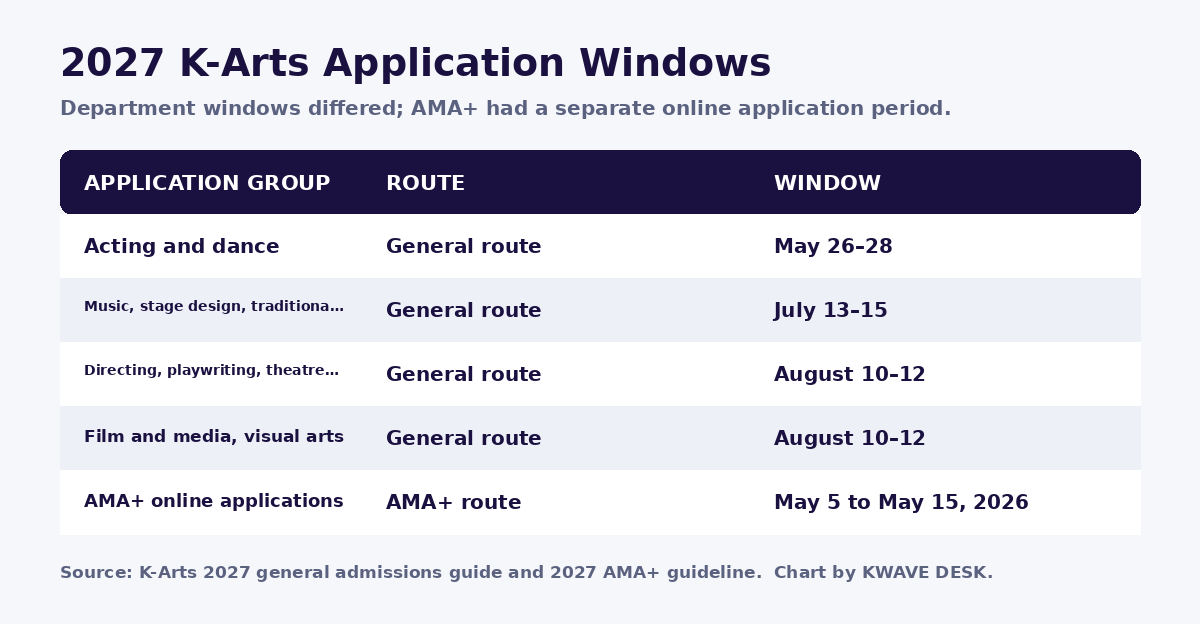
K-Arts published its 2027 undergraduate admissions guide for overseas Koreans and international applicants on April 7, 2026. The same notice warned applicants to keep checking the page for later corrections. Ten days later, on April 17, 2026, the school announced a separate 2027 AMA+ scholarship intake, with online applications open only from May 5 to May 15, 2026, Korea time. Both application windows have closed. This guide is not a prediction of the next cycle’s exact dates. It is a route-selection audit: an order of checks you can run before you spend money on documents, translation, or shipping.
Two K-Arts Routes That Applicants Often Confuse
K-Arts runs two separate international admission paths, and they are not the same program. The general international undergraduate route is a non-quota admission track covering music, drama, film and media, dance, visual arts, and Korean traditional arts. According to K-Arts, the architecture degree under this route runs five years, while the other undergraduate courses run four years. The AMA+ scholarship route is a separate, nationality-limited intake with its own eligibility rule, its own calendar, and its own benefits package. Neither route is an idol-training program; both lead to a performing arts or visual arts degree inside a university admissions structure.
Confusing the two wastes time. A Canadian applicant who does not meet the AMA+ citizenship condition may still qualify for the general route. A student who assumes AMA+ is simply “the scholarship version of the general route” may discover the citizenship rule disqualifies them only after preparing documents. Checking eligibility first, before picking a major or paying any fee, avoids both mistakes.
Check Eligibility Before Choosing a Major
Before researching a specific department, confirm eligibility in this order: applicant and parent citizenship, school-history category, recognized graduation credential, and then the chosen department’s separate language and portfolio requirements. Skipping ahead to audition prep or major selection before this step risks preparing for a route you cannot actually enter.
For the general international undergraduate route, K-Arts required applicants to qualify through at least one specified category. Published categories included completing the full primary and secondary curriculum abroad, or having both the applicant and both parents hold foreign nationality. Applicants should read the full category list on the official guide, since only one qualifying category needs to be met, but it must be met exactly as published.
- Confirm which passport(s) you and both parents hold, including every nationality in dual-citizenship cases.
- Map your actual schooling — country, curriculum type, and years completed — against the published categories.
- Confirm you hold (or will hold) a recognized graduation credential before the application period.
- Only after the above, check your target department’s TOPIK level, portfolio format, and major-specific documents.
A Warning for GED, Homeschool and Online-School Applicants
According to K-Arts’ general admissions guide, GED-style examinations, homeschooling, and cyber-learning courses were not recognized as completion of the required school curriculum. The guide listed one exception, a separate provision for North Korean defectors, which does not apply to most international applicants. Our reading: this restriction is the single most commonly missed point in the general route, because many overseas families assume any accredited alternative schooling will count. If your education history includes GED credits, homeschool years, or online-school enrollment, do not assume you qualify. Contact the K-Arts Admissions Division directly and request written confirmation of your eligibility before paying for apostille, notarization, translation, or international shipping of transcripts. Spending on document authentication before confirming eligibility is the most avoidable cost in this entire process.
2027 General International Admissions by School
The 2027 general route used three separate application windows, split by department rather than by a single universal deadline. Acting and dance applications ran May 26–28. Music, stage design, and traditional arts applications ran July 13–15. Directing, playwriting, theatre studies, film and media, and visual arts applications ran August 10–12. As of November 11, 2026, all three 2027 deadlines have passed.
Our reading: the split calendar is easy to miss if you only check the K-Arts homepage once. A department you plan to apply to in a later cycle may open and close its window months before a related department does. Anyone tracking the next admissions cycle should note their target department’s specific round, not just “the K-Arts deadline,” since there isn’t only one.
Costs and Submission Method
For the general undergraduate route, the application fee was KRW 88,000, with a separately listed KRW 6,000 online processing fee. Required documents had to be sent by registered mail during the applicable submission period for the applicant’s department. This means the process combined an online application step with a physical mailing step, and missing the mailing window could affect an otherwise completed online application. Readers planning for a future cycle should confirm both the online portal deadline and the registered-mail cutoff separately, since the guide listed them as part of the same submission process rather than interchangeable options.
AMA+ Is Not a Scholarship Open to Every International Student
AMA+ is frequently described informally as “the K-Arts scholarship for international students,” but the actual eligibility rule is much narrower than that phrase suggests. According to the official 2027 AMA+ guideline, AMA+ was restricted to applicants whose own citizenship and both parents’ citizenship met the OECD DAC recipient-country condition. In dual-nationality cases, every citizenship the applicant or either parent held had to satisfy this condition, not just one.
Our reading: this rule means residence or school location does not establish eligibility. A student who grew up in the United States or Canada, or who attended school there, is not automatically eligible for AMA+, because the test is citizenship, not residence or education location. Readers should not assume eligibility based on where they live or studied. The only reliable method is checking the official eligible-country appendix published with the AMA+ guideline, applicant by applicant and parent by parent, rather than guessing from general knowledge of OECD DAC categorizations.
Korean Ability Is a Major-Specific Gate
The 2027 AMA+ guide required applicants to meet the Korean-language level set by their chosen department. Requirements varied significantly by major. For example, undergraduate acting required TOPIK Level 6 plus a Korean self-introduction video and acting videos, while undergraduate multimedia required TOPIK Level 3 and a free-format portfolio. These are substantially different thresholds within the same scholarship program, so checking the correct department’s requirement matters more than checking a general AMA+ language standard.
The guide also explained that K-Arts’ internal language test, used after document screening, would not replace a TOPIK score. Our reading: this is a commonly missed point. Applicants sometimes assume that performing well on the school’s own language assessment after submitting documents can substitute for an official TOPIK certificate. According to the official guideline, it cannot. A valid TOPIK score at the level your department requires remains necessary regardless of how the internal test goes.
What the AMA+ Package Covers
The 2027 AMA+ package listed specific, itemized benefits rather than a general living-cost estimate. According to the official guideline, it included full regular-semester tuition, entry and graduation economy airfare, Korean-language training, National Health Insurance contributions, and a monthly allowance of KRW 800,000. The guideline also noted that the monthly allowance could be adjusted under the rules in force at the time of enrollment.
Readers should treat this list as the verified scope of benefits, not as a full personal budget. Cost-of-living estimates beyond these listed items are not part of the official guideline and should not be treated as confirmed figures. This article does not provide immigration, visa, or legal advice; applicants with visa or residency questions should consult the relevant Korean government authority or a qualified immigration professional directly.
Which Documents Should Be Checked First
Before paying for apostille, notarization, translation, or international shipping, confirm the underlying facts those documents are meant to prove. Document costs are only worthwhile once eligibility and major requirements are already clear.
- Passports and family-nationality evidence for the applicant and both parents, checked against the relevant route’s citizenship rule.
- Complete school records matching one of the general route’s published categories, or confirmation that your schooling type is recognized.
- Proof of graduation status, since a recognized graduation credential was part of the general route’s eligibility check.
- Official language scores — specifically TOPIK, at the level your target department requires under AMA+, if applying through that route.
- The exact portfolio specification for your chosen major, since formats differed by department in the AMA+ guideline.
Only after these five points are confirmed does it make sense to pay for authentication, translation, or registered international shipping of the supporting paperwork.
Editor’s Take
Our reading: the two routes serve different populations, and conflating them is the most expensive mistake an applicant can make. The general route’s citizenship-and-schooling categories can include applicants from the United States, Canada, or similar countries, provided their specific education history matches a published category. AMA+’s OECD DAC citizenship condition is a much narrower filter, applied to the applicant and both parents, regardless of where the family currently lives.
Our reading: the practical risk is sequencing. Applicants who choose a major, start portfolio work, or pay for document authentication before confirming citizenship and schooling eligibility may discover late that they do not qualify for the route they prepared for. Running the eligibility check first costs nothing but time.
Before You Apply
- Re-check the official K-Arts admissions notice page directly, since the school stated it may publish later corrections to the 2027 guide.
- Review the official AMA+ guideline and its eligible-country appendix before assuming citizenship eligibility.
- Confirm your target department’s specific application window, since rounds differ by major and area.
- Verify your department’s exact TOPIK level and portfolio format directly from the official guideline rather than general summaries.
- Remember that K-Arts states it has no designated overseas study institute or official admissions agency; treat paid intermediaries claiming official K-Arts status with caution.
Related Reading
- Girls Planet 2027 Audition Guide: Eligibility, Videos and the Survival-Show Debut Path
- How to Audition for a Korean Entertainment Company: Requirements, Videos and What Agencies Say They Want
Sources
- 한국예술종합학교 입학정보 · 2026-04-07
- 한국예술종합학교 · 2026-04-07
- Korea National University of Arts · 2026-04-17
- Korea National University of Arts · 2026-04-17
- Korea National University of Arts